
Medication Calculations for Nurses: Step-by-Step Guide with Easy Examples
Meta Title:
Medication Calculations for Nurses: Step-by-Step Guide with Easy Examples
Meta Description:
Learn how to master medication calculations for nurses with step-by-step methods, formulas, and easy examples. Perfect for nursing students and practicing nurses!
—-💊 Introduction:
Why Medication Calculations Matter in Nursing accurate medication calculation is one of the most critical skills every nurse must master. A small error in drug dosage can lead to serious patient harm. Whether you’re a nursing student preparing for exams or a registered nurse working on the floor, understanding how to calculate doses correctly builds confidence, safety, and trust in patient care.
In this guide, you’ll learn step-by-step formulas, shortcut methods, and real-life examples to make medication calculations simple and stress-free.
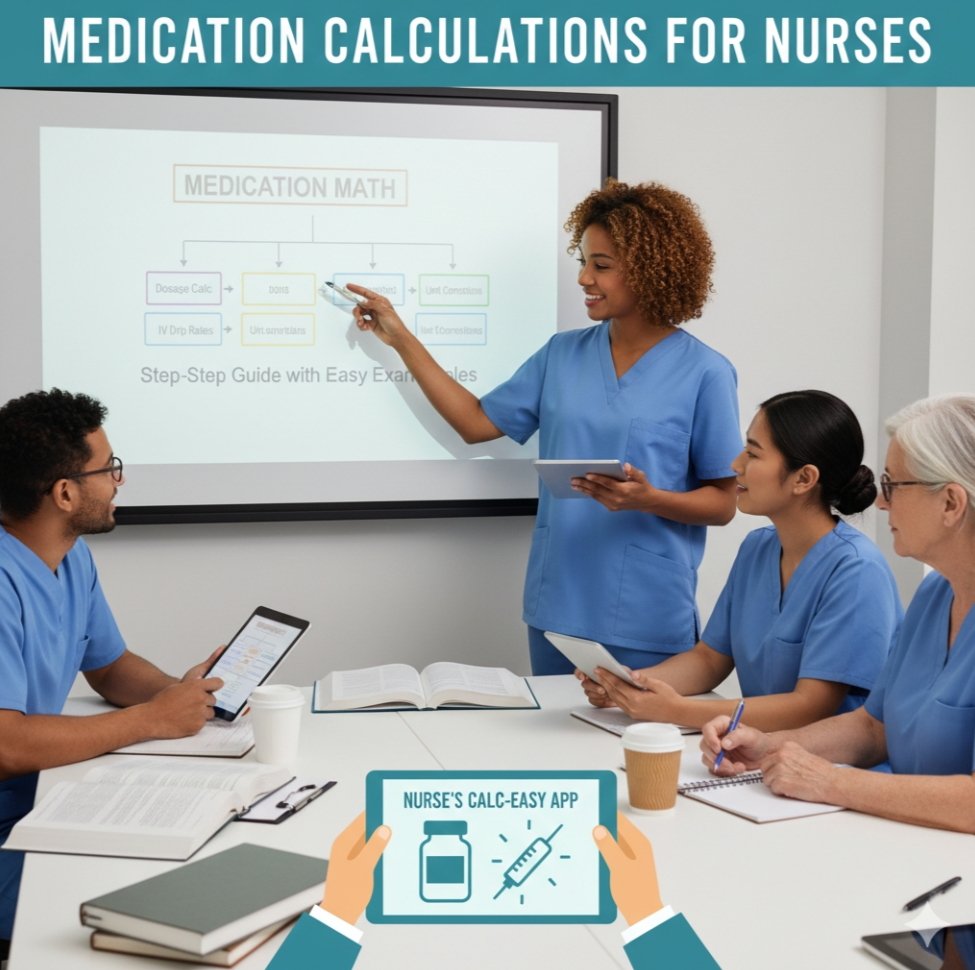
—-🧠 The Basics of Medication Calculations
Before you dive into the formulas, let’s review some essential units and conversions every nurse should know:
✅ Common Units
Weight: 1 kg = 1000 g = 1,000,000 mg
Volume: 1 L = 1000 mLTime: 1 hour = 60 minutes
✅ Basic Conversion Examples
500 mg = 0.5 g
1.5 L = 1500 mL
250 µg = 0.25 mg
Always double-check whether your medication order is in mg, µg, or g, as confusion between these units can lead to major errors.
––🩺 Step-by-Step Formula for Medication Calculation
Let’s start with the most used formula in nursing:
Formula:\text{(Desired Dose ÷ Stock Strength)} × Stock Volume = Dose to Administer
Example 1:
Doctor’s order: 250 mg of Amoxicillin Stock on hand: 500 mg/10 mL
Calculation:(250 ÷ 500) × 10 = 5 mL👉 You need to give 5 mL of the medication.-
–-💉 IV Infusion Rate Calculation
When giving IV medications, nurses must know how to calculate infusion rates in mL/hour or drops/minute.
Formula for mL/hour:\text{Volume (mL)} ÷ \text{Time (hours)} = \text{Rate (mL/hour)}
Example 2:
IV order: 1000 mL Normal Saline over 8 hours Calculation:1000 ÷ 8 = 125 mL/hour
👉 Set the IV pump to deliver 125 mL/hour.
Formula for Drops per Minute (Manual Drip Set):\text{(Volume × Drop Factor)} ÷ (Time in minutes) = \text{Drops per minute}
Example 3:
Order: 500 mL over 4 hours
Drop factor: 20 drops/mL
Calculation:(500 × 20) ÷ (4 × 60) = 41.6 ≈ 42 drops/min
👉 Regulate IV at 42 drops/min manually.-
–💊 Pediatric Dose Calculation
Children’s doses are usually based on weight (mg/kg). Always double-check your calculation with a second nurse.
Formula:\text{Child’s dose} = \text{Weight (kg)} × \text{Dose per kg}
Example 4:
Order: Paracetamol 15 mg/kg
Child’s weight: 20 kg
Calculation:15 × 20 = 300 mg
👉 Give 300 mg of Paracetamol.
—💧 IV Drip Rate Using Time and Volume
Sometimes, doctors order IV fluids like:“500 mL Normal Saline over 5 hours.
”Formula:\text{Rate (mL/hour)} = \frac{\text{Volume (mL)}}{\text{Time (hours)}}
Example 5:
500 ÷ 5 = 100 mL/hour
👉 Set the IV infusion pump to 100 mL/hour.
—-💊 Dosage Calculation When Tablets Are Involved
formula:\text{(Desired dose ÷ Stock dose)} × Number of tablets = Tablets to Give
example 6:
Order: 250 Mg
stock: 500 mg tablets
Calculation:(250 ÷ 500) × 1 = 0.5 tablet
👉 Administer half a tablet.
—⚖️ Weight-Based IV Medication Example some
IV medications like Dopamine are calculated based on micrograms/kg/minute.
Formula:\text{Dose (µg/min)} = \text{Weight (kg)} × \text{Prescribed dose (µg/kg/min)}
Example 7:
Dopamine 5 µg/kg/min
Patient weight = 60 kg
Calculation:5 × 60 = 300 µg/min
👉 Now convert to mL/hour using the solution concentration (usually given on the label).

—💬 Nurse’s Tips for Accurate Medication Calculations
1. ✅ Always double-check — especially high-risk drugs like insulin or heparin.
2. 🧾 Use a calculator — avoid mental math for critical doses.
3. 👥 Verify with another nurse before giving pediatric or IV medications.
4. 🕐 Check the label twice — once when taking the drug and once before administration.
5. ⚖️ Be aware of unit conversions — microgram vs milligram confusion can be deadly.
6. 💬 Ask if unsure — never guess medication doses.
—📚 Practice Makes Perfect
The more you practice medication calculations, the more confident and accurate you become. Try solving daily dosage problems, use mobile nursing apps, or attend calculation workshops offered by your hospital or nursing school.
Remember -Confidence in dosage calculation equals confidence in patient safety.
🩵 Final Thoughts
Medication calculations don’t have to be scary! With a little practice, focus, and patience, any nurse can master it. Use these formulas and examples daily until they become second nature.Remember — safe nursing practice starts with accurate dosage calculations.
🧠 Frequently Asked Questions (FAQ)
1. Why are medication calculations important for nurses?
Medication calculations ensure that patients receive the correct dose of medicine safely. Even a small error can cause harm, so accurate math helps prevent medication errors and improves patient outcomes.
—2. What are the basic formulas for medication calculations?
The most common formula used is:\text{(Desired Dose ÷ Stock Strength)} × Stock Volume = Dose to Administer
—3. How can I get better at nursing math and medication calculations?
Practice daily! Use online quizzes, flashcards, or apps designed for nursing students. Double-check units (mg, g, mL) and always use a calculator for accuracy. Many nurses improve quickly with consistent practice.
––4. Are there any free tools or apps to help with medication calculations?
Yes! Some great tools include:NurseMath,MedCalc,Calculate by QxMD, Nursing.com app,These apps help you calculate IV rates, dosages, and conversions quickly.
––5. What’s the best way to avoid medication errors as a nurse?
Follow the Five Rights of Medication Administration:1. Right patient
2. Right drug
3. Right dose
4. Right route
5. Right time
6.Right Documentation
7.Right Refuse
8.Right Response
9.Right Education
10.Right education